
Both trials above were concluded in record time, drawing public outrage and public condemnation.
In the Kenya of the 1970s and 1980s, ships with American Marines frequently docked at Kenya’s Port of Mombasa for periods of up to 6 weeks, were much awaited and anticipated by the business community in the city of Mombasa, and by commercial sex workers too, because the Marines, sometimes numbering as many as 1,500 came loaded with cash, were generous with their money, lived large and spent large.
The legend even goes that that when big numbers of Marines landed and stayed for periods of up to six weeks, the most “hard working” of commercial sex workers would return back to their rural homes, after the departure of the Marines, buy small pieces of land, construct rental units, start small businesses, or all three, and “live happily ever after.”
South Korean Navy personnel also docked frequently at the port of Mombasa back in those days, though the South Koreans were tight with money and not as popular as the American Marines.
The South Koreans though were bullies, frequently started fights and frequently left without paying bills, until locals in Mombasa laid a trap for them around February 1988, gave all the South Korean Navy personnel a thorough beating, and then paraded them through the streets of Mombasa. South Korea Navy personnel never misbehaved in Mombasa again.
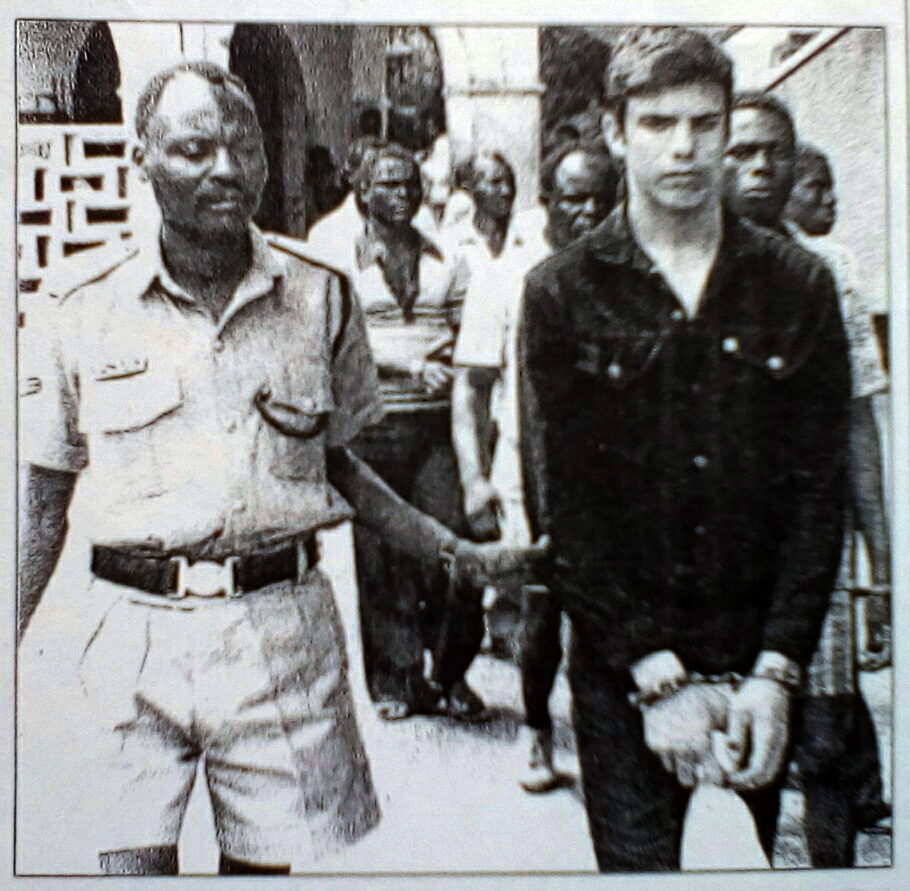
Below verbatim, are the said above events of 1980 involving American Marine Frank Joseph Sundstrom in image above, as published by Kenya’s Nation Media Group in 2003, in the commemorative series “Kenya@40,” marking 40 years of independence in Kenya:
“In September 1980, Justice L.G. Harris acquitted 19-year-old American Marine Frank Joseph Sundstrom (accompanying image), and ordered him to deposit a 500 Kenya Shilling bond and be of good behaviour for two years after he admitted killing Monica Njeri, a Mombasa twilight girl. “I can’t believe it,” exclaimed Sundstrom’s mother, “justice has been done.”
Kenyans did not agree and the Sundstrom manslaughter verdict became the focus of an intense fury with a Judiciary seen as being compromised. Indeed, things have never been the same in the corridors of justice. Regardless of protests across the board, Sundstrom walked home smiling and Kenyans were left trying to make sense of the verdict.
The question that has never been answered is: did the United States Government intervene to have it’s sailor freed? At the time, the US military wanted to venture into Kenya in a low profile and set up military facilities in Nanyuki, Mombasa and Nairobi, as agreed with the two-year-old Government of Daniel arap Moi. This followed Moi’s State visit to the US during which Washington agreed to donate yellow maize to Kenya and forge closer defence ties.
Monica Njeri, a mother of two – Jane Wanjiku and Teresia Wangeci – met Sundstrom on 3rd August 1980 at Florida Night Club, Mombasa. The court was told that they had agreed to have sex for 300 Kenya Shillings for the night. At Florida and in the company of another woman named Margaret, they drank beer and smoked “bhang” (marijuana).
They later left with Njeri for her Ganjoni flat and had sex. Sundstrom felt cheated when Njeri fell asleep and refused to make love again. He tried to steal the money he paid her and they started fighting. He hit Njeri with a beer bottle and then stabbed her several times with the broken bottle. Sundstrom, who arrived in Kenya aboard the US Warship “La Salle,” admitted the crime.
The case raised many questions about the administration of justice in Kenya. But the main accusation was directed not at the Executive but at the then White-dominated Judiciary. During Charles Njonjo’s days as Attorney-General, there was a deliberate move to bar Africans from ascending to key positions in the Judiciary.
But while murder cases involving Kenyans dragged on for months and suspects were remanded for lengthy periods, the Sundstrom case took a record two months from crime to verdict.”
 Kenyan_History
6 thoughts on “Frank Joseph Sundstrom and the killing on the night of 3rd August 1980 of Monica Njeri, in Mombasa, Kenya”