Warm Greetings from Kenya, in East Africa, and a warm welcome too here to this website, Kenyan History, which has 250 postings, 209 of them on Kenyan History, and 41 of them on World History. Please feel free to scroll down briefly for a glimpse of the postings here at Kenyan History. All 250 postings here at Kenyan History though, their subject matter and their links, are listed at the following WordPress link i.e. https://kenyapostcardsandkenyaphotos.wordpress.com/2023/12/14/the-website-https-kenyanhistory-home-blog-has-250-postings-on-kenyan-history-and-world-history-of-the-250-postings-209-of-them-are-on-kenyan-history-and-41-of-them-are-on-world-history-the-subje/
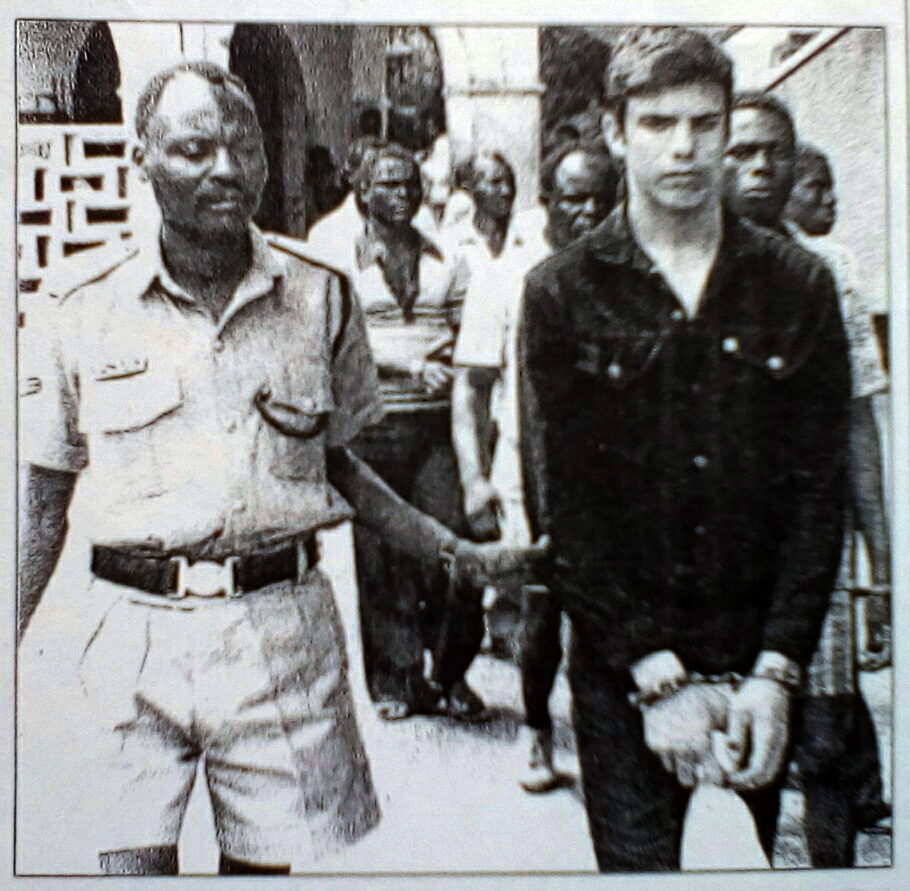
The image above is courtesy of the year 2003 publication “Kenya@40” by Kenya’s Nation Media Group, marking 40 years of Kenya’s independence, and the guy on the right of image above is 19-year-old American Marine, Frank Joseph Sundstrom, who in September 1980, was acquitted by the High Court of Kenya sitting in Mombasa, for the murder on the night of 3rd August 1980, of commercial sex worker Monica Njeri. In 1983 too, another American Marine, James William Tyson, was acquitted for the murder of commercial sex worker Lucy Kabura. Both trials above were concluded in record time, drawing public outrage and public condemnation. In the Kenya of the 1970s and 1980s, ships with American Marines frequently docked at Kenya’s Port of Mombasa for periods of up to 6 weeks, were much awaited and anticipated by the business community in the city of Mombasa, and by commercial sex workers too, because the Marines, sometimes numbering as many as 1,500 came loaded with cash, were generous with their money, lived large and spent large. The legend even goes that that when big numbers of Marines landed and stayed for periods of up to six weeks, the most “hard working” of commercial sex workers would return back to their rural homes, after the departure of the Marines, buy small pieces of land, construct rental units, start small businesses, or all three, and “live happily ever after.” South Korean Navy personnel also docked frequently at the port of Mombasa back in those days, though the South Koreans were tight with money and not as popular as the American Marines. The South Koreans though were bullies, frequently started fights and frequently left without paying bills, until locals in Mombasa laid a trap for them around February 1988, gave all the South Korean Navy personnel a thorough beating, and then paraded them through the streets of Mombasa. South Korea Navy personnel never misbehaved in Mombasa again. Below verbatim, are the said above events of 1980 involving American Marine Frank Joseph Sundstrom in image above, as published by Kenya’s Nation Media Group in 2003, in the commemorative series “Kenya@40,” marking 40 years of independence in Kenya: “In September 1980, Justice L.G. Harris acquitted 19-year-old American Marine Frank Joseph Sundstrom (accompanying image), and ordered him to deposit a 500 Kenya Shilling bond and be of good behaviour for two years after he admitted killing Monica Njeri, a Mombasa twilight girl. “I can’t believe it,” exclaimed Sundstrom’s mother, “justice has been done.” Kenyans did not agree and the Sundstrom manslaughter verdict became the focus of an intense fury with a Judiciary seen as being compromised. Indeed, things have never been the same in the corridors of justice. Regardless of protests across the board, Sundstrom walked home smiling and Kenyans were left trying to make sense of the verdict. The question that has never been answered is: did the United States Government intervene to have it’s sailor freed? At the time, the US military wanted to venture into Kenya in a low profile and set up military facilities in Nanyuki, Mombasa and Nairobi, as agreed with the two-year-old Government of Daniel arap Moi. This followed Moi’s State visit to the US during which Washington agreed to donate yellow maize to Kenya and forge closer defence ties. Monica Njeri, a mother of two – Jane Wanjiku and Teresia Wangeci – met Sundstrom on 3rd August 1980 at Florida Night Club, Mombasa. The court was told that they had agreed to have sex for 300 Kenya Shillings for the night. At Florida and in the company of another woman named Margaret, they drank beer and smoked “bhang” (marijuana). They later left with Njeri for her Ganjoni flat and had sex. Sundstrom felt cheated when Njeri fell asleep and refused to make love again. He tried to steal the money he paid her and they started fighting. He hit Njeri with a beer bottle and then stabbed her several times with the broken bottle. Sundstrom, who arrived in Kenya aboard the US Warship “La Salle,” admitted the crime. The case raised many questions about the administration of justice in Kenya. But the main accusation was directed not at the Executive but at the then White-dominated Judiciary. During Charles Njonjo’s days as Attorney-General, there was a deliberate move to bar Africans from ascending to key positions in the Judiciary. But while murder cases involving Kenyans dragged on for months and suspects were remanded for lengthy periods, the Sundstrom case took a record two months from crime to verdict.”
The above image was taken in Nairobi, Kenya, on 21st May 1962: Left to right are Ronald Ngala, Kenya’s Minister of State in charge of Administration, G. Mennen Williams, America’s Assistant Secretary of State for African Affairs, and Jomo Kenyatta, Kenya’s Minister of State for Constitutional Affairs and Economic Planning. There is now a largely forgotten chapter of Kenyan History i.e. that in 1962 Colonial Kenya Governor Sir Patrick Renison constituted a Coalition Government that ran from 1962 to 1963 of the Kenya African National Union (KANU) and the Kenya African Democratic Union (KADU). Jomo Kenyatta of KANU and Ronald Ngala of KADU were joint Chief Ministers of the Coalition Government of 1962 to 1963, Sir Patrick Renison remained the overall incharge as Colonial Kenya Governor, and as mentioned, the Cabinet portfolios of Jomo Kenyatta and Ronald Ngala were Minister of State for Constitutional Affairs and Economic Planning and Minister of State in charge of Administration, respectively. Image above courtesy of the University of Michigan, USA
Both above images are of the meeting of the year 1898 at Ngong between Laibon Lenana (2nd right), leader of the Maasai of Kenya in those days, and Commissioner of the East Africa Protectorate (as Kenya was known then), Sir Arthur Henry Hardinge (extreme left). Sir Arthur Henry Hardinge was Commissioner of the East Africa Protectorate (as Kenya was known then) from 1895 to 1900 and was posted to Kenya with the key task of supervising the construction of the Kenya-Uganda Railway Line of 1896 to 1901. Kimathi Street, Nairobi, used to be known as Hardinge Street, named after Sir Arthur Henry Hardinge. Point Lenana, the third highest peak on Mt. Kenya, at 4,985 metres above sea level, is named after Laibon Lenana. Lenana School, Nairobi, is also named after Laibon Lenana. The original of above image is black & white (lower image), and the upper image is a colourised version generated using free colourisation software on the internet. The British were clever i.e. they did not use brute force, not entirely anyway, in building their empire, in acquiring their vast and expansive colonies, protectorates and dominions i.e. they used “soft skills” like “treaties,” as captured in accompanying images, in their imperialism and expansionism. “Treaties…?” Yes Sir Arthur Henry Hardinge, on behalf of Her Majesty Queen Victoria, and Laibon Lenana, on behalf of the Maasai, must have “signed a treaty” on the day of their meeting in 1898 in accompanying image, transferring vast land holdings from the Maasai to Her Majesty Queen Victoria and the British. The kind of “treaty” that must have been signed between Sir Arthur Henry Hardinge, on behalf of Her Majesty Queen Victoria, and Laibon Lenana, on behalf of the Maasai, was later replicated across Kenya with all and different Kenyan communities. It is indeed through such “treaties,” as mentioned, that the British acquired their vast and expansive colonies, protectorates and dominions, not just in Africa, but in other parts of the world too, including America, Canada, the Caribbean, Asia and the Oceania
The image above is the cover of “The Weekly Review” Magazine of 10th March 1975 with the headline “Bombs rock Kenya.” There were a series of bombings in Kenya in 1975 attributed to what was referred to as “Maskini Liberation Army” (MLA) i.e. Liberation Army of the lower classes of Kenya, though “Maskini Liberation Army” (MLA) was clearly a fabrication and concoction of President Jomo Kenyatta’s regime to create panic in the Kenyan public. Nyandarua North Member of Parliament, Josiah Mwangi Kariuki (J.M. Kariuki), was brutally murdered on 2nd March 1975, and immediately before J.M. Kariuki was murdered, he was due to catch a bus from Nairobi to Mombasa on 28th February 1975, though J.M. Kariuki cancelled his trip to Mombasa at the last minute. The bus J.M. Kariuki was meant to catch to Mombasa belonged to what used to be known as the Overseas Trading Company (OTC), and OTC’s main depot in Nairobi back then used to be situated off Landhies Road, slightly past the the junction of Landhies Road and Ronald Ngala Street, in the direction towards Haile Selassie Avenue. There was a major explosion at the OTC bus depot on 28th February 1975, and in particular, an OTC bus with passengers was blown up, the bus J.M. Kariuki was meant to have used on his trip to Mombasa before he cancelled his trip at the last minute. Over 20 people died in the OTC bus explosion of 28th February 1975. After J.M. Kariuki was murdered on 2nd March 1975, there was dissent, disaffection and resentment across Kenya, and in a show of assertion and bravado, President Jomo Kenyatta abruptly and uncharacteristically inspected a Guard of Honour mounted by the Kenyan Armed Forces on a weekday on Nairobi’s Government Road, today Moi Avenue. There was then a fly past by Kenya Air Force jets after President Jomo Kenyatta inspected the said Guard of Honour. Around the time too, at a public function, President Jomo Kenyatta said to those gathered that no one would just sit back and do nothing if a leopard kept coming week after week to capture one of his or her livestock, that he or she would take action of one kind or another to ensure the leopard never came back again. After saying this to those gathered President Jomo Kenyatta declared “I am the leader of this country, and when I say stand up, you stand up… Simameni! i.e. ‘Stand up’ in Kiswahili.” Everyone present, without exception, stood up, President Jomo Kenyatta looked around for a few seconds to confirm this, and then told everyone that they could now sit down once more
The image above is courtesy of “The East African” newspaper of 3rd to 9th March 1997, with a caption that reads as follows: “Wouse with Kenyan Chiefs visiting the United Kingdom (Britain) in 1948. They are from left: Chief Okwiri, Mr. J. Ngatia and Chief Mohamed Stambul.” The “Wouse” mentioned above i.e. Leslie Edward “Wouse” Whitehouse, was a District Commissioner in Colonial Kenya
The above undated image is of Kenya’s Young Kikuyu Association (YKA), is courtesy of Kenya History and Biographies Limited, and below, courtesy of Britannica and Wikipedia, is a brief history of the Young Kikuyu Association (YKA): The Young Kikuyu Association (YKA) was formed in Kenya on 10th June 1921 as a break away organisation from the Kikuyu Association (KA). In July 1921 the Young Kikuyu Association (YKA) was renamed the East Africa Association (EAA). Harry Thuku, who had previously been Secretary-General of the Kikuyu Association (KA), felt that the Kikuyu Association (KA) was not adequately acting on reversing the declaration of Kenya as a British colony, effective 1st January 1920, feeling that the matter of the reversal of Kenya’s declaration as a British colony, needed to be taken up directly with the British Colonial Secretary in Britain. The first demonstrations against the declaration of Kenya as a British colony were staged in 1921 by the Harry Thuku led East Africa Association (EAA). In 1925 the East African Association (EAA) was banned, with it’s members re-grouping and forming the Kikuyu Central Association (KCA). The Kikuyu Central Association (KCA) morphed into the Kenya African Study Union (KASU) in 1944, KASU in turn, transformed into the Kenya African Union (KAU) in 1947. The Kenya African Union (KAU) became the Kenya African National Union (KANU) on 14th May 1960 with KANU leading Kenya to independence on 12th December 1963
Both images above are of “Equator Sound Band” best remembered for their 1972 hit song “Pole Musa” sang in Kiswahili. The lady they are with is one of their fans and left to right are Nashil Pichen Kazembe (from Zambia), Fadhili William (from Kenya), Charles Sonko (from Uganda) and Peter Tsotsi (from Zimbabwe). The original of above image is black & white (lower image), and the upper image is a colourised version generated using free colourisation software on the internet. As mentioned, “Equator Sound Band’s” best known song is “Pole Musa” and is posted at YouTube at the following YouTube link https://youtu.be/xrCl65_oTDA
The image above is courtesy of the Kenya National Archives (KNA) and was quite likely taken during the visit to Kenya of 1928 by Edward, Prince of Wales, later King Edward VIII, because standing extreme left is Paramount Chief Kinyanjui wa Gathirimu who was born around the year 1865, and who passed away in 1929. Paramount Chief Kinyanjui wa Gathirimu was rather westernised and anglicised and there are even images of him smoking cigars. There is even an image of Paramount Chief Kinyanjui wa Gathirimu when Edward, Prince of Wales visited Kenya in 1928, seated and looking regal, surrounded by aides in slick and chique suits. Standing fourth from right is a youthful Chief Njiiri wa Karanja, who went on to become one of the powers behind the throne in Colonial Kenya, featuring at major events in Colonial Kenya, such as the visit to Kenya of 1952 by British Colonial Secretary Oliver Lyttelton, the official opening of the new buildings of Parliament in 1954, the visit to Kenya of 1956 by Princess Margaret of the United Kingdom, and the visit to Kenya of 1957 by British Colonial Secretary Alan Lennox-Boyd. There is even an image taken of Chief Njiiri wa Karanja during Kenya’s State of Emergency of 1952 to 1959, seated smoking a cigar in the company of Gen. George Erskine and three other White gentlemen
The first female Cabinet Minister in Britain was Margaret Bondfield (extreme left, top row, above collage), Labour Minister from 1929 to 1931. There is then a long gap until 1979 when Margaret Thatcher (middle of top row, above collage) became British Prime Minister, serving as British Prime Minister from 1979 to 1990. And Margaret Thatcher never actually served as a British Cabinet Minister before she became British Prime Minister, she was leader of the opposition Conservative Party between 1975 and 1979. The Conservative Party won the British elections of 1979 and in Britain the leader of the party that wins an election automatically becomes British Prime Minister. In America, the 1st female Cabinet Minister was Frances Perkins (extreme right, top row, above collage), Secretary of Labour i.e. Minister of Labour, from 1933 to 1945. There is then a long gap until the year 1977 when Patricia Roberts Harris (extreme left, bottom row, above collage), an African-American, served in three different Cabinet portfolios from 1977 to 1981. There is then Elizabeth Dole (middle of bottom row, above collage) who served in Cabinet from 1983 to 1990, and then Madeleine Albright (extreme right, bottom row, above collage) who was Secretary of State i.e. Minister for Foreign Affairs, from 1997 to 2001. After Albright there has been a steady flow of female Cabinet Ministers in America. The first female Prime Minister in the world was Sirimavo Bandaranaike of Sri Lanka, elected to office in 1960. Others include Indira Gandhi of India, first elected Prime Minister of India in 1966, and Golda Meir of Israel, Prime Minister of Israel from 1969 to 1974. The first female President in the world was Vigdis Finnbogadottir of Iceland, elected to office in 1980. Here in Kenya, Prof. Julia Ojiambo was the first female Assistant Minister, appointed in 1974, and the first Kenyan female Cabinet Minister was Winifred Nyiva Mwendwa, appointed in 1995. Since the Kenyan elections of 2002 there has been a steady flow of Kenyan female Cabinet Ministers, including Charity Ngilu, Martha Karua, Beth Mugo, Prof. Hellen Sambili, Prof. Margaret Kamar, Dr. Naomi Shaban, Esther Murugi, Amb. Amina Mohamed, Prof. Judy Wakhungu, Sicily Kariuki, Amb. Raychelle Omamo and Dr. Monica Juma. With regard to the above comparisons, is Kenya proactive or not, is Kenya lagging behind or keeping up?



 Kenyan_History